Article Synopsis
Duke Point blends industrial scale with circular economy practice, where waste becomes feedstock and material recirculation underpins new business models. Firms such as Generating Resources for Tomorrow, West Coast Reductions, Convertus, and Nanaimo Forest Products demonstrate high-recovery processing and rapid local distribution. The site’s deep-water terminal, ferry freight and Highway 1 access reduce haul times and operating costs, sharpening supply-chain efficiency. For investors, the park offers exposure to margin-accretive, resource-efficient operations anchored by modern logistics. This reframes industrial land as strategic infrastructure for sustainable manufacturing and materials logistics.
Industrial lands seldom merit the same attention as many of the celebrated fixtures of a city, yet Duke Point is a surprising case where the character of a city has seeped into the work done there. It shows that industry can do more than adjust to new expectations. In several cases, it is thriving in ways that did not seem likely a generation ago. This evolution is as much about place as it is about practice: at Duke Point, industrial lands are being remade around circular economy principles, where waste is treated as feedstock and material recirculation form the backbone of new business models, and modern logistics help turn local streams of material into reliable supply chains.
The Default Conversation: Scale, Cost, and Capacity
Industrial land is usually treated as background infrastructure, places people notice only when they provide jobs, pay taxes, or create issues. Conversations about industry tend to focus on things like scale, compliance costs, and yard capacity rather than a narrative about place or values. That makes Duke Point unusual.
Profit and Purpose in New Industrial Models
Most companies there are built around circular practices from the start, treating waste as feedstock, and proving that efficient, circular operating models can outperform conventional ones.
What Circularity Means for Industry
Canadians produce over 25 million tonnes of “waste” per year, roughly the mass of 5,000 S-Class BC ferries. Circular businesses have found a niche by treating this supposed waste as feedstock. The system shifts from take-make-waste to take-make-use, which slows extraction and reduces the load on landfills.
Case Studies in Material Recirculation
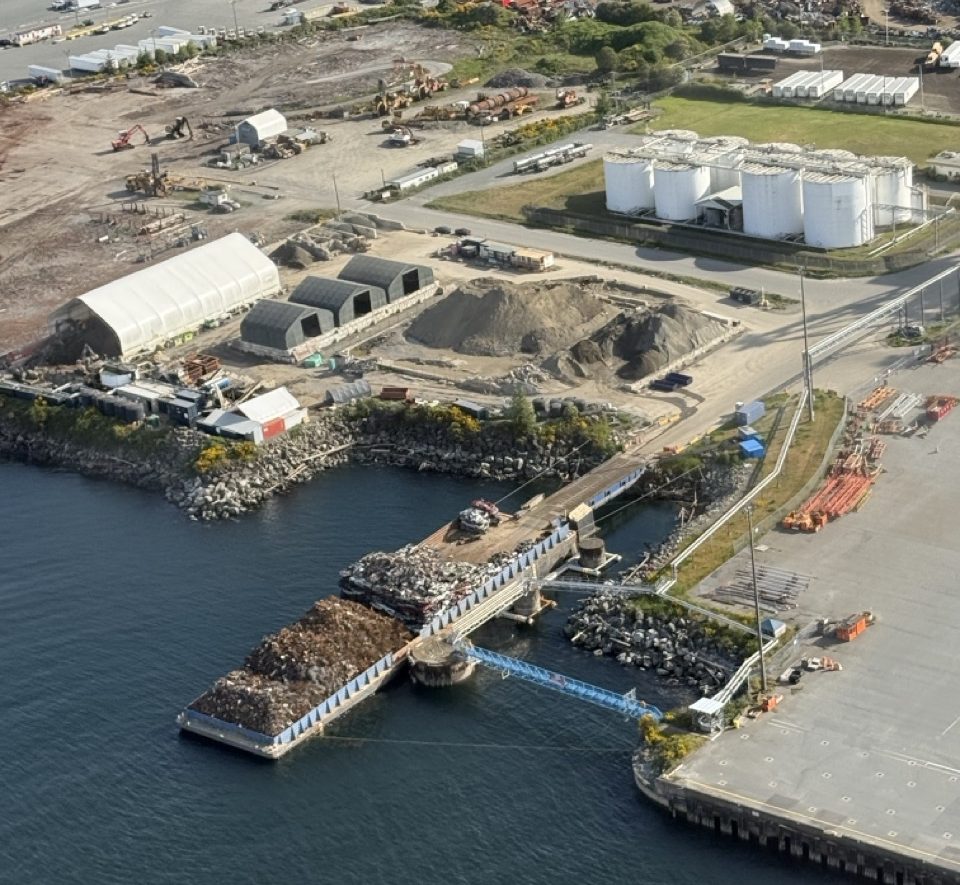
Seen through that lens, Duke Point becomes a catalogue of circular practice. Generating Resources for Tomorrow (GRT) recovers about 95 percent of contaminated soils for reuse as clean aggregates, offering a lower cost and lower impact alternative to increasingly expensive quarry rock. West Coast Reductions turns a billion pounds of inedible animal by-product per year into fats and protein meal that re-enter supply chains rather than entering landfills. Each year, Convertus pushes up to 60,000 tonnes of organic waste through a tight in-vessel system that produces batches of Class A compost in just two weeks. Nanaimo Forest Products closes loops on wood fibre, chemicals, heat and logistics, even sending excess steam into the power grid. Metal yards and auto dismantlers keep steel and parts in circulation. Each of these firms have found profit in other’s refuse, or, to use the adage, treasure in another’s trash.
How Have These Circular Businesses Come to Be Based in Duke Point?
Part of the answer is cultural. Nanaimo doesn’t lean toward smokestack manufacturing. The region’s norms around environment, recreation, and quality of life make resource-efficient, lower-waste models especially competitive. That sensibility shows up in Duke Point’s tenant mix. The other part is practical: the infrastructure is built for modern logistics.
The Practical Geography of Duke Point
The industrial park sits on deep water with an active cargo terminal, regular short sea shipping to the Mainland, direct ferry freight services and immediate access to Highway 1., meaning trucks can load, move, and exit without crossing through the city. Heavy power capacity, ample parcels, and separation from residential areas let firms run energy intensive operations without friction. It is a spot designed for handling material, moving it quickly, and keeping costs predictable.
Speed and Proximity as Operational Assets
For circular businesses, these advantages are practical. GRT moves recovered aggregates straight into regional construction markets through short, efficient haul routes. West Coast Reductions ships fats and protein meals directly off site from Duke Point’s terminal. Convertus benefits from being near both inputs and regional users of finished compost. Nanaimo Forest Products operates its own deep sea berth next door, which means fibre, chemicals and finished pulp move through a controlled, local system. Both DP Auto Recyclers and ABC Recycling rely on the same pattern: fast intake, fast processing, fast outbound.
Duke Point as Proof of a Different Industrial Future
All of this explains why these industries are not just compatible with Duke Point but almost inevitable there. The location is built around steady, material-based work, and the city’s culture leans toward businesses that make more out of what already exists. The result is a cluster that mirrors our city’s strengths: practical innovation, resource efficiency, and the ability to turn local material flows into economic opportunity.
If you are interested in opportunities or are looking for more information, visit out latest Duke Point Industrial Park Land Profiles
for brochures and availability.
Reach out to our Business Development Manager, Sherese Johnson, for further inquiry: sherese@investnanaimo.com.