Nanaimo is the first city in North America to adopt doughnut economics, joining cities such as Amsterdam, Melbourne, and Berlin already witnessing success from this well-being economy. In place of economic growth as the single marker for city well-being, combining values of economy, society and environment, help to balance a city’s development.






The World is Changing.
And so is Nanaimo.
In concert with economic interests, the City of Nanaimo is measuring quality of life with other metrics. While GDP is traditionally used to measure economic productivity, the inclusion of environmental and social impacts along with economic development leads to more balanced and sustainable outcomes.
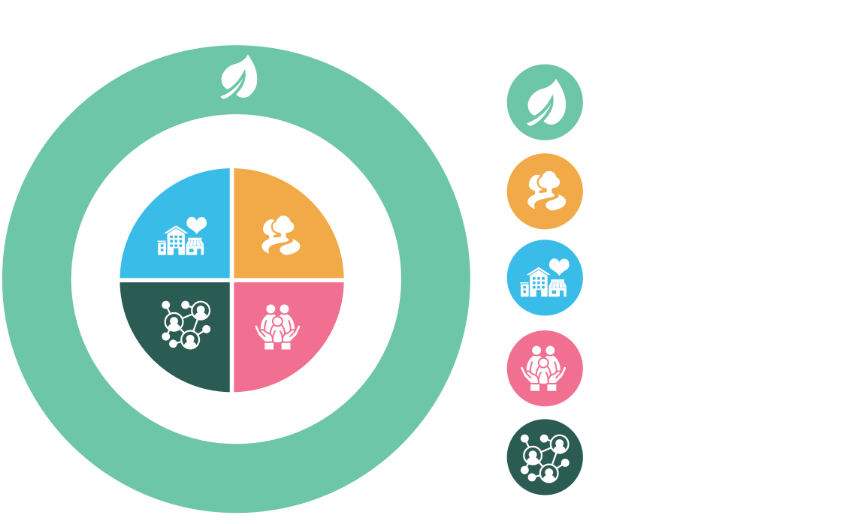
The City recognizes that environment, society, and economy are deeply interconnected and cannot be separated. Decisions need to be made with the ecological ceiling and social foundation in mind to avoid exacerbating social and environmental issues. Doughnut economics seeks to establish systems that are intentionally distributive and regenerative. In doing so, doughnut economics seeks to ensure that all members of society have access to high levels of care and support.
During the development of Nanaimo’s community plan Nanaimo Reimagined, it was noted that there was no adequate method to assess whether the community or environmental sustainability was improving. The Doughnut Economic Model was identified as a way to provide targets and markers to track progress while addressing social and environmental impacts of economic decisions.
To bring those measures to life, the City has now developed the Nanaimo Monitoring Bar, a visual summary of progress on 23 key indicators tied to the city’s five goals (Green, Connected, Healthy, Empowered, Prosperous). Each reporting bar shows whether performance is within a sustainable range, or if improvements are still needed. This tool helps illustrate where Nanaimo is operating sustainably and where gaps remain, and provides a way to communicate progress over time.
Doughnut Economics
Action Lab
In 2012 Kate Raworth, an Oxford University economist, developed an alternative economic system that operates within planetary capacities and is built upon a strong social foundation. The model diverts attention from the familiar exponential upward curve of endless growth to a reinforcing, circular system—akin to that of a doughnut.
For more about the Doughnut Economic Model, visit the Doughnut Economics Action Lab.


The Province of BC is Committed to
a Balanced Economy
Although in its early stages, the BC Ministry of Finance also recognizes the need to align the province to realistic and sustainable economic goals. Environmental, social, and governance (ESG) values are placed at the forefront of economic decision making. The BC economy is now geared towards meeting sustainability goals to accelerate climate action and build a cleaner BC.
In this next economic iteration, the province seeks to mitigate the shortcomings of previous economic models that have exacerbated current housing, affordability, and environmental crises. Doughnut economics however proves to show more dimension and expands upon the province’s ESG mandate.
Nanaimo stands proudly as the first, and still the only North American city to embrace the Doughnut Economics model of balance. In embracing the Doughnut Economic Model. Nanaimo is leading the way in redefining economic success. It’s only the beginning. There is much to be done. We’ll need to make decisions and track development to measure success. Come join the adventure!

Want to help
shape the future?