Article Synopsis
Collaboration often fails not because of bad actors but because systems rooted in scarcity and competition create collective action problems. Elinor Ostrom's eight Core Design Principles, adapted by ProSocial World, identify what effective groups have in common: shared identity and purpose, equitable distribution of costs and benefits, inclusive decision-making, monitoring of agreed behaviours, graduated responding to helpful and unhelpful behaviour, fast and fair conflict resolution, authority to self-govern, and collaborative relations with other groups. A community assessment in Nanaimo, BC, facilitated by Dr. Paul Atkins of ProSocial World with Nanaimo Foundation and Vancouver Island University, found inclusive decision-making to be the weakest area, while shared purpose and autonomy scored highest. Improving collaboration starts small, building trust in individual relationships, and scales into broader systems change over time.
Across the city, dedicated people show up every day, working hard to make things better. Yet, despite these efforts, we don’t always see the collective results we aim for.
Breakdowns in collaboration are rarely driven by bad actors. More often, they are shaped by the systems within which we work. Rooted in scarcity, competition, and resource protection, these systems can unintentionally pit people and organizations against one another. Each group operates rationally within its own context: protecting its mandate, holding onto data, or prioritizing internal targets. But when everyone acts in isolation, the system as a whole produces fragmentation, duplication, and gaps.
Even when people act in their best interests, collective outcomes can fall short because many challenges are collective action problems where individual incentives don’t align with shared outcomes. The question is how we can improve trust and collaboration.
The Outer Work: Designing for Collaboration
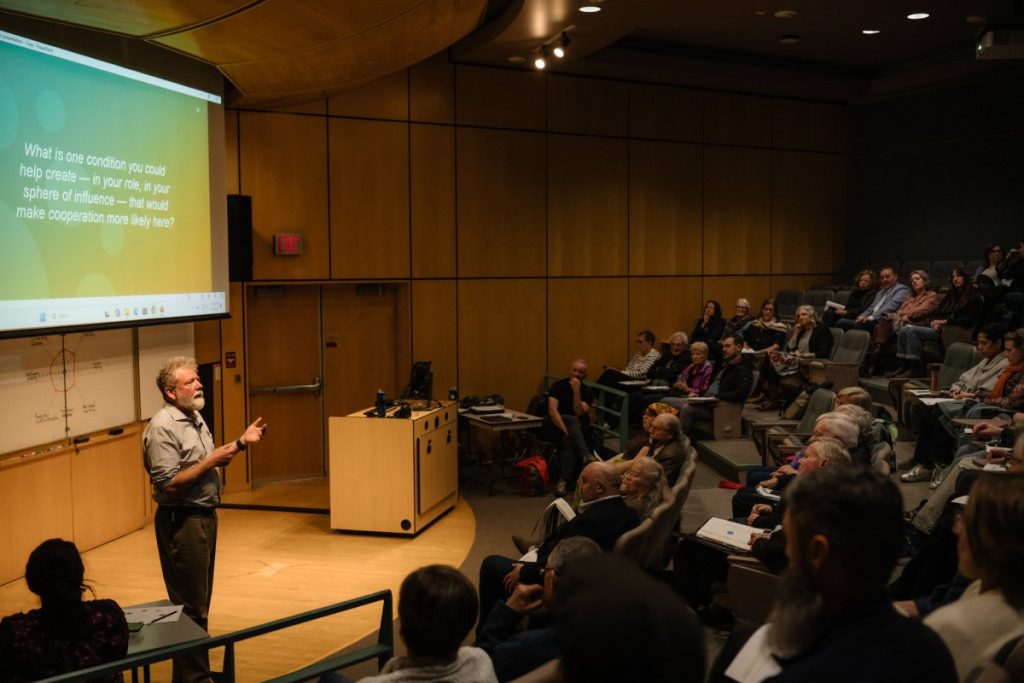
On April 8, we invited Dr. Paul Atkins, co-author and founder of ProSocial World, together with our partners Nanaimo Foundation and Vancouver Island University, to guide a conversation on how we can build collaborative capacity in our community.
Drawing on the work of Elinor Ostrom, he shared a simple but powerful idea: “It is difficult to change human nature, but we can change the systems we operate in.”
Ostrom was the first woman to receive the Nobel Prize in Economics for her work studying how communities manage shared resources. From hundreds of real-world examples, she identified eight recurring features of groups that collaborate effectively, called the Core Design Principles. ProSocial has adapted these principles for broader use:
- Shared identity and purpose
Do people feel they are on the same team, working toward the same goal? - Equitable distribution of costs and benefits
Are costs and benefits shared fairly? Are the needs of all being met? - Inclusive decision-making
Do the people most affected have a real say in decisions? - Monitoring of agreed behaviours (transparency)
Can people see whether promises and agreements are being kept? - Graduated responding to helpful and unhelpful behaviour
To what extent do people respond appropriately to encourage helpful and discourage unhelpful behaviour? - Fast and fair conflict resolution
Is there a trusted way to resolve disagreements quickly? - Authority to self-govern (according to principles 1 to 6). Do groups have enough freedom to set and adjust their own rules ?
- Collaborative relations with other groups (using principles 1 to 7). Do groups work effectively with other groups and institutions across the wider system?
These principles describe the conditions that successful groups tend to have in place and what struggling groups are often missing.
A Snapshot of Nanaimo
During the session, participants reflected on how Nanaimo’s broader ecosystem performs across the eight principles. Results showed that:
- Inclusive decision-making scored the lowest. Many felt that those most affected by decisions do not have meaningful opportunities to shape them.
- Shared purpose and autonomy in coordination scored the highest, suggesting that while there is general alignment in intent, there is also flexibility in how groups organize themselves.
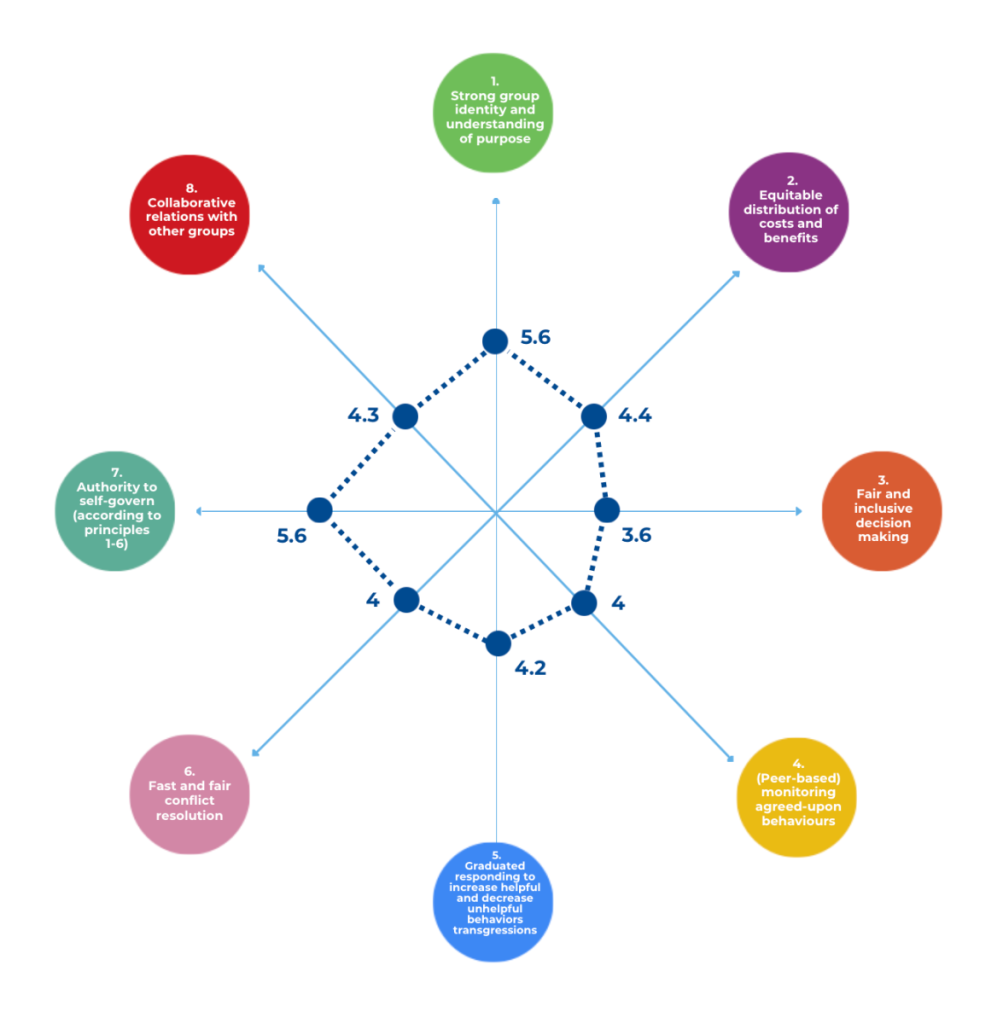
The ProSocial Spoke Diagram shows how the group rated the broader Nanaimo community ecosystem across the eight Core Design Principles.
The Inner Work: Building the Collaborative Muscle
While the design principles create the conditions for collaboration, they only come to life when people engage with them. Like a muscle, it is strengthened through consistent, balanced and intentional practice.
This means having better conversations where people can express what matters most to them and what concerns them, and building self-awareness to notice when we act from protection rather than shared purpose.
We asked participants what values matter most for improving cooperation in Nanaimo; they emphasized accountability, transparency, equity, respect, and trust. At the same time, they named the feelings that make collaboration difficult, including cynicism, distrust, frustration, exhaustion, overwhelm, and fear.
A key takeaway was to let values lead, without ignoring the feelings that exist. Change doesn’t happen all at once. It often starts small by improving one relationship or making one agreement more transparent. Over time, these small steps can add up to meaningful systems change.
Moving Forward
Human beings are remarkably capable of working together. Our ability to form groups and adapt to changing conditions is one of our greatest strengths. But collaboration doesn’t happen automatically. It needs to be designed, practiced, and sustained.
Strengthening Nanaimo’s collaborative muscle starts by building the conditions for collaboration and making space for honest conversations. If you are interested in applying the Core Design principles in your own team, ProSocial has developed a step-by-step guide that you can adapt to your context.
We are all part of the system, and we all have a role in shaping it.